Tuesday, August 31, 2010

HEALTH FROM THE TEAPOT


Herbs fit for cold days.

Nature is rich in medicinal herbs and each has its own effect. But what herb is grown against which complaints? The National Association of Statutory Health Insurance Physicians has compiled a selection of herbs that help with colds, gastro-intestinal discomfort and stress.


Colds are major challenges for the immune system of the body. Elderflower, meadowsweet and lime flowers to support the body's immune system and stimulate the healthy sweat. Also, currant and mint tea and tea from oregano provide relief for colds. With thyme, primrose, plantain or licorice expectoration is excited. Care for dry cough marshmallow or Iceland moss for a soothing protective layer on the mucous membranes of the respiratory tract. Specifically to combat throat infections helps gargling with sage or chamomile tea.


Even in disorders such as anorexia or bloating which nature provides the right herbs. Yarrow, wormwood, gentian, centaury and dandelion can help here, since their bitter promote the gastric juice production. Anyone suffering from flatulence should put more on the essential oils from anise, peppermint or fennel. Anti-convulsant effect fennel, anise and cumin.


Relaxing and sleep inducing effect of valerian tea, passion flower, hops, lemon balm and lavender. St. John's wort for mild depression and is awarded to soothing effect. Thus the effect of relaxing herbal tea is felt, it is necessary to drink them regularly over a long period of time.


The pleasure of a steaming cup of herbal tea is always a break in the hustle and bustle of everyday life and can provide more comfort. Therefore, make sure whether their symptoms are probably a more serious cause, If symptoms resolve after a few days are not very strong, or regularly recur, you should always consult your doctor.

Sunday, August 29, 2010

AUTUMN BLUES - the gloom SELL


Hamburg (ots) - Between autumn and winter, about 800,000 people in Germany suffer from so-called autumn blues - by experts as "seasonal affective disorder (SAD) called. Common symptoms: a high need for sleep, lack of drive, mood swings, cravings for sweets and concentration difficulties. Here are some tips:


The main reason is lack of light.

On exposure to light, the body produces endorphins increased - also known as endorphins. Moreover, in light of the neurotransmitter serotonin distributed, brightens the mood. In the darkness, melatonin is produced, which makes us weak and tired. So go out every day at least fifteen minutes outside to soak up the sunlight and fresh air. Even on cloudy days of autumn and winter the sun is out three to four times as strong as the room lighting.


Proper nutrition affects our mood.

The mineral magnesium is important for our well-being. Good food sources of magnesium include, for example bananas, lentils, nuts and dried fruits. The mood is mentioned such as serotonin in carbohydrate-rich foods such as pasta and potatoes. Also fatty acids from deep sea fishing, such as herring and mackerel or vegetable oils such as canola and soybean oil lift the mood.


Exercise helps with depression.

Physical activity improves the psychological well-being because it is the body's own endorphins (endorphins, serotonin, dopamine) distributed. Cheap sports that drive the dark clouds around the mind are, for example, jogging, walking, cycling and skiing. The best effect is achieved with regular, moderate endurance training: Ideally, three to five times per week for 30 to 60 minutes - less beginners.

Moving Animals: Spectacular Animal Films (Part 2)

3. The Animals Film (Beyond the Frame 1981, 137min)

To my knowledge, The Animals Film was the first documentary to me made on the animal protection movement and the first to be aired on public television--an amazing feat given that it was released just 6 years after the publication of Animal Liberation, 1 year after Henry Spira's ad campaign against Revlon, 2 years before The Case for Animal Rights, and 3 years before Unnecessary Fuss. Filmed in the United States by an Israeli and released in England, TAF had been the most comprehensive film on animal welfare up until the release of Earthlings 16 years later. Yet, despite its age, sadly, little has changed since its release except that industry practices and problems have increased in magnitude and extended into other countries. (In 1980, about 5 billion animals were slaughtered in America annually compared to nearly 9 billion by 2000). In fact, it is my opinion that despite the praise for Earthlings and the absence of knowledge about this film, TAF is better. (Whether it is more effective at recruiting vegans--Earthlings supposedly is nicknamed "the Vegan maker"--, that is for empirical studies to determine).

Read more »

Saturday, August 28, 2010

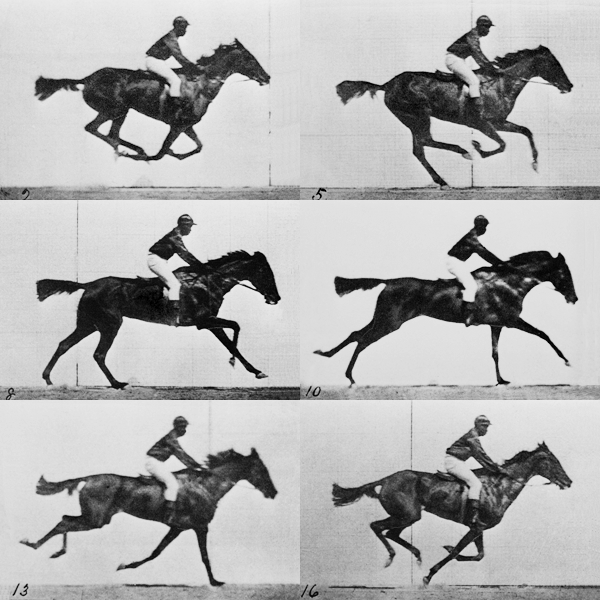
Moving Animals: Spectacular Animal Films (Part 1)

Eadweard Muybridge's "The Horse in Motion" (1878)
"Animals: The Most Moving Things in the World"
--Jim Mason in An Unnatural Order (2005 [1993])

“The animal look can be seen as a continuation of the photographic look... Animals appeared to merge with technological bodies that replaced them... If the animal cannot die but is nonetheless vanishing, then it must be transferred to another locus, anther continuum in which death plays no role... the cinema developed, indeed embodied, animal traits as a gesture of mourning for the disappearance of [animals]"
--Akira Lippit in Electric Animal (1998)


Moving Animals, Animal Affect, and Effective Movies
Since its inception, the animal movement has relied upon images to evoke sympathy--from William Hogarth's "The Four Stages of Cruelty" (1751) that connected cruelty to animal to cruelty to humans, to the anti-vivisectionist posters that re-figured the medical oppression of women to that of animal others, and PETA's "Holocaust on Your Plate" and "Animal Liberation" exhibits that juxtaposed images of human and nonhuman oppression. Undercover investigation footage of labs, in particular, played a crucial role in the 1980's, especially within the efficacy of the ALF and PETA (videos like Unnecessary Fuss and Inside Biosearch). However, with increased vandalism and exposure, the Animal Industrial Complex has been vigilant to guard its practices from public knowledge. Since the 1990's, these industries have installed hi-tech security systems in addition to lobbying for the Animal Enterprise Terrorism Act [AETA], which gained increasing government backing post-9/11. Such footage, has been crucial to educating the public about animal welfare within the age of televisions, computers, and cinema. Over the last decade, activists have even accompanied themselves with video harnesses to literally carry the animals' voices to protests and demos.

Read more »

Saturated Fat, Glycemic Index and Insulin Sensitivity: Another Nail in the Coffin

Insulin is a hormone that drives glucose and other nutrients from the bloodstream into cells, among other things. A loss of sensitivity to the insulin signal, called insulin resistance, is a core feature of modern metabolic dysfunction and can lead to type II diabetes and other health problems. Insulin resistance affects a large percentage of people in affluent nations, in fact the majority of people in some places. What causes insulin resistance? Researchers have been trying to figure this out for decades.*

Since saturated fat is blamed for everything from cardiovascular disease to diabetes, it's no surprise that a number of controlled trials have asked if saturated fat feeding causes insulin resistance when compared to other fats. From the way the evidence is sometimes portrayed, you might think it does. However, a careful review of the literature reveals that this position is exaggerated, to put it mildly (1).

The glycemic index, a measure of how much a specific carbohydrate food raises blood sugar, is another darling of the diet-health literature. On the surface, it makes sense: if excess blood sugar is harmful, then foods that increase blood sugar should be harmful. Despite evidence from observational studies, controlled trials as long as 1.5 years have shown that the glycemic index does not influence insulin sensitivity or body fat gain (2, 3, 4). The observational studies may be confounded by the fact that white flour and sugar are the two main high-glycemic foods in most Western diets. Most industrially processed carbohydrate foods also have a high glycemic index, but that doesn't imply that their high glycemic index is the reason they're harmful.

All of this is easy for me to accept, because I'm familiar with examples of traditional cultures eating absurd amounts of saturated fat and/or high-glycemic carbohydrate, and not developing metabolic disease (5, 6, 7). I believe the key is that their food is not industrially processed (along with exercise, sunlight exposure, and probably other factors).

A large new study just published in the American Journal of Clinical nutrition has placed the final nail in the coffin: neither saturated fat nor high glycemic carbohydrate influence insulin sensitivity in humans, at least on the timescale of most controlled trials (8). At 6 months and 720 participants, it was both the largest and one of the longest studies to address the question. Participants were assigned to one of the following diets:
  1. High saturated fat, high glycemic index
  2. High monounsaturated fat, high glycemic index
  3. High monounsaturated fat, low glycemic index
  4. Low fat, high glycemic index
  5. Low fat, low glycemic index
Compliance to the diets was pretty good. From the nature of the study design, I suspect the authors were expecting participants on diet #1 to fare the worst. They were eating a deadly combination of saturated fat and high glycemic carbohydrate! Well to everyone's dismay except cranks like me, there were no differences in insulin sensitivity between groups at 6 months. Blood pressure also didn't differ between groups, although the low-fat groups lost more weight than the monounsaturated fat groups. The investigators didn't attempt to determine whether the weight loss was fat, lean mass or both. The low-fat groups also saw an increase in the microalbumin:creatinine ratio compared to other groups, indicating a possible deterioration of kidney function.

In my opinion, the literature as a whole consistently shows that if saturated fat or high glycemic carbohydrate influence insulin sensitivity, they do so on a very long timescale, as no effect is detectable in controlled trails of fairly long duration. While it is possible that the controlled trials just didn't last long enough to detect an effect, I think it's more likely that both factors are irrelevant.

Fats were provided by the industrial manufacturer Unilever, and were incorporated into margarines, which I'm sure were just lovely to eat. Carbohydrate was also provided, including "bread, pasta, rice, and cereals." In other words, all participants were eating industrial food. I think these types of investigations often run into problems due to reductionist thinking. I prefer studies like Dr. Staffan Lindeberg's paleolithic diet trials (9, 10, 11). The key difference? They focus mostly on diet quality, not calories or specific nutrients. And they have shown that quality is king!


* Excess body fat is almost certainly a major cause. When fat mass increases beyond a certain point, particularly abdominal fat, the fat tissue typically becomes inflamed. Inflamed fat tissue secretes factors which reduce whole-body insulin sensitivity (12, 13). The big question is: what caused the fat gain?

Friday, August 27, 2010

EXHAUSTION - CMS


Who is tired and exhausted all the time, the demands of everyday life does not feel equal and loses interest in hobbies and social contacts. In particular, women with family burden are often beyond the point of physical and mental exhaustion. There are often physical side effects such as black before the eyes of standing up, a tendency to sweating and cold hands, sensitivity to the weather and accelerated pulse. Very often there is an increased susceptibility to infectious diseases. Psychiatric side effects are performance and lack of concentration, insomnia, feeling overwhelmed, lack of motivation and anhedonia.


Fatigue occurs most often after serious illness. The body is weakened by the process of the disease, often are deficiencies in front of vitamins, minerals and trace elements. Observed especially in the elderly doctors often that a flu infection lasts for weeks and months on the acute symptoms and also manifests itself in tiredness and listlessness. On the other hand, exhaustion may also be the first symptom at the beginning or before the outbreak of various diseases (eg infectious diseases, tumors) should be. More and more often occurs with the chronic fatigue syndrome, or CMS for short, on,. Leaden fatigue and exhaustion, after only small loads are the main symptoms of this disease. Other physical symptoms may be added: muscle and joint pain, lymph node swelling and almond, increased body temperature, cardiovascular disorders and headaches. The cause is unknown; the involvement of the immune system is likely. At the beginning of the chronic fatigue syndrome is often the flu or flu-like symptoms.

Common causes
* After-effect of serious diseases.
* Blood pressure.
* Stress.
* Syndrome Due to a constant load
(Sleep disturbances and psycho-vegetative symptoms).
* Sleep disorders.
* Iron deficiency, iodine deficiency.
* Hypothyroidism.
* Early symptom of various diseases.
* Chronic fatigue syndrome (CFS)

What can you do?

* The physical regeneration of vitamin B12 preparations in capsule form or vials in the recovery time and prevent a vitamin deficiency by the administration of multivitamin preparations: Against the aftermath of serious disease.

* Get up slowly, brushing and massage spray shower, invigorating shower or bath use with rosemary, enjoy their morning coffee or black tea: At low blood pressure. Sport and exercise in between. During the day, drink plenty much. Best herbal tea and sodium-rich mineral water.

* For stress: seriously signals of exhaustion. Not everything will always make perfect, make tasks. To admit to do anything once. Sensory overload, for example avoided through radio, television.

* In depressive mood disorders: mild depressive states respond well to treatment with St. John's wort. In the winter, often staying in daylight outside, because on shorter days, many people of the organism on gentle cycle and often results in a low mood.

* For insomnia: Check bedtime and sleeping space, eg not too much alcohol before bedtime and a quiet room for sleeping are important prerequisites. Take warm baths with sleep-inducing herbal supplements.

* Chronic fatigue syndrome: strengthening the immune system with vitamins and nutrients or other preparations for defense increase.

When you need a doctor?


At constant tiredness related to the above symptoms.

What your doctor can do?


* Exclusion of severe organic disease.

* Detection of low blood pressure, iron or iodine deficiency or chronic fatigue syndrome.

* The causes of fatigue treatment.

* Proposals for a therapy to reduce fatigue symptoms do.

Prevention:

Balanced, nutritious diet, sports and exercise, not smoking, low alcohol, adequate sleep, meaningful exchange between stress and relaxation.

Wednesday, August 25, 2010

ALSO SUGAR FREE cornet sweeten the START


Protects the teeth healthy for enrollment…

For many children means the end of the summer vacation this year again a simultaneous new begins, because the enrollment is coming. Contend with anticipation small-graders the first day, contrary, and the means for the whole family a special event. In celebration of the day it is next to a family party traditionally a cornet for the first graders. Not without reason, this also often carries the name sugar cone. Partly enough a quick look in the bag to determine that the content is anything but kind to teeth and fails even more, not contributing much sense to enrollment. "Although a few sweets are included, but with a little thought you can quickly find tooth-friendly alternatives that protect children from tooth decay."

With imagination prevent tooth decay besides sweets; there are many things with which to fill cones. Just at the time of the school year shows again and again, do the curious children through life. For pleasure, therefore, also provide sugar-free alternatives to sweeten their way, the upcoming school years. Instead of a surfeit of sweets such as toys offer fun for a much longer period. Pencils and books, skipping ropes or colored chalk for painting the road is only a few of the alternatives for filling the cornet. Also extra for the school presents selected as bread boxes or gym bag with their favorite motifs of the little expand the opportunities to make sense of the bags to pack. Naturally, the kids do not completely give up sweets. "When parents look for when buying gear on the small male on the packages, then they do the teeth of their children a big favor". Because it contains sugars cause tooth decay. In addition, nuts are to feast on delicious cookies or letters, also known as Russian bread. Especially sugar-free chewing gum not only tastes delicious but also the supporting dental health. "However, the caution of not listening to the day of enrollment up again. In the bread box from the cornet of course also includes healthy food for the next break time."

Related Posts Plugin for WordPress, Blogger...